
DBC & AMB Ceramic Substrates: What to Check Before You Order
DBC & AMB Ceramic Substrates: What to Check Before You Order
If you’re specifying substrates for a power module, you already know the datasheet doesn’t tell you everything. Two suppliers can quote the same thickness, the same copper weight, and the same alumina grade, and still hand you wildly different real world performance. The difference usually shows up later, in the field, after the batch is already soldered onto boards.
Here’s what actually matters when choosing between DBC and AMB substrates, and what to ask a supplier before you commit to an order.
DBC vs AMB: What's the Real Difference?
DBC (Direct Bonded Copper)
Bonds copper foil straight onto a ceramic base, typically alumina or aluminium nitride, using a high temperature eutectic bonding process. There’s no adhesive and no solder layer sitting between the copper and the ceramic. That’s what gives DBC substrates their combination of good thermal conductivity, solid electrical isolation, and decent mechanical strength in one package.
AMB (Active Metal Brazing)
Takes it a step further. Instead of a direct copper to ceramic bond, AMB uses an active metal braze alloy, usually containing titanium, to join copper to ceramics that don’t bond as cleanly through the standard DBC process. Most importantly this includes aluminium nitride and silicon nitride. It’s why AMB has become the go to choice for high power IGBT and SiC modules where thermal cycling reliability really matters.
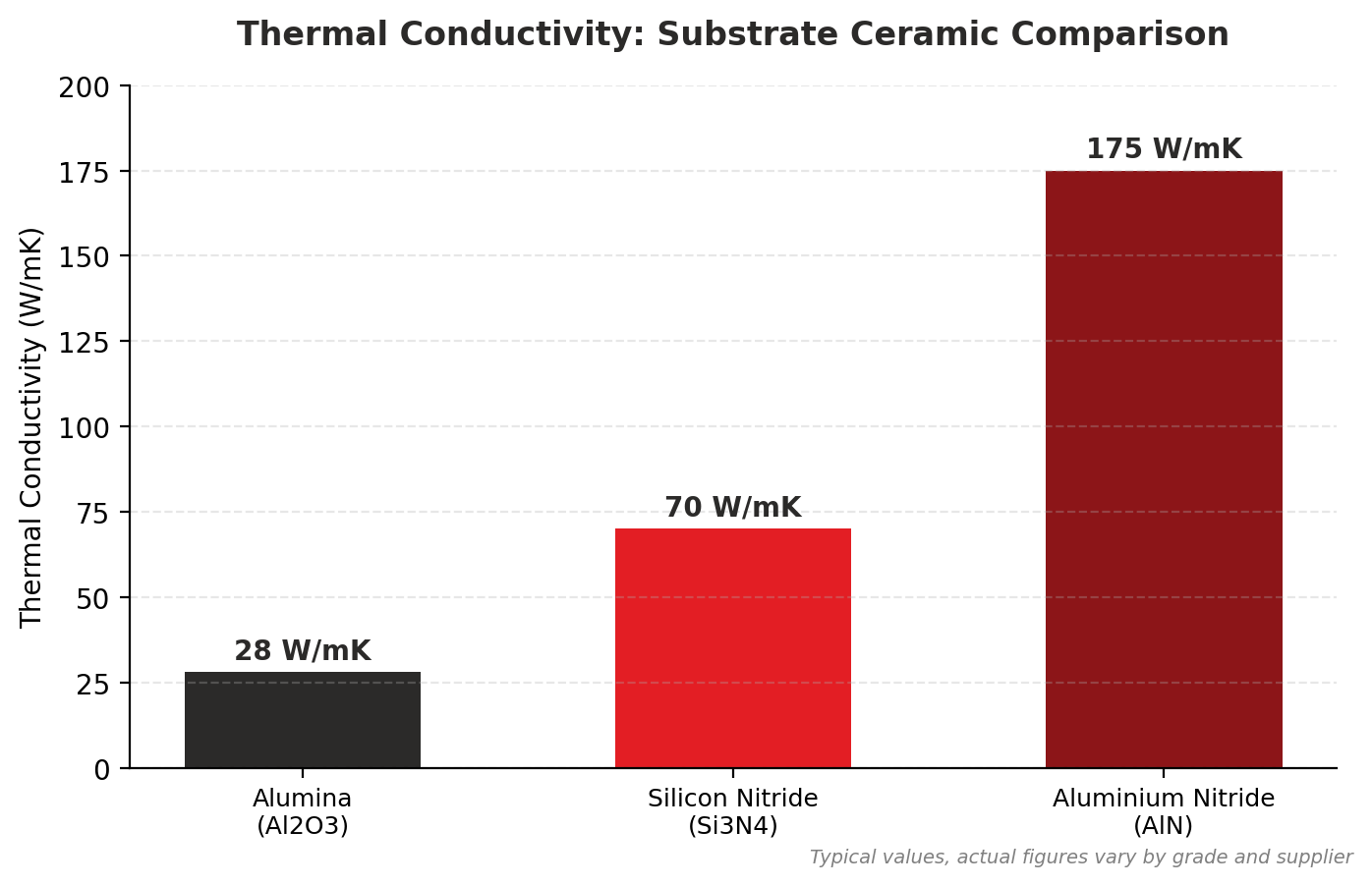
If your application runs at high power density with frequent thermal cycling (EV inverters, traction modules, industrial drives), AMB on AlN or Si₃N₄ is usually worth the extra cost. For a more moderate thermal load, DBC on alumina (Al₂O₃) is often the more economical and perfectly reliable choice.
DBC and AMB Ceramic Substrate Ordering Checklist
Keep the following information ready when requesting a quotation:
| Requirement | Details to Provide |
|---|---|
| Substrate Type | DBC or AMB |
| Ceramic Material | Al₂O₃, AlN, or Si₃N₄ |
| Ceramic Thickness | Required value |
| Copper Thickness | Top and bottom |
| Dimensions | Length × width |
| Circuit Pattern | Technical drawing |
| Tolerances | Critical dimensions |
| Surface Requirement | As per assembly process |
| Operating Temperature | Minimum and maximum |
| Electrical Requirement | Voltage and insulation |
| Application | IGBT, SiC, EV, inverter, etc. |
| Quantity | Prototype or production |
What Are DBC Ceramic Substrates?
DBC stands for Direct Bonded Copper. In a DBC ceramic substrate, copper is bonded directly to the surface of a ceramic material using a controlled high-temperature process.The result is a structure that provides:
- Good heat dissipation
- High electrical insulation
- Strong copper-to-ceramic bonding
- Good current-carrying capability
- Compact circuit integration
- Suitable performance for power electronics
Common ceramic materials used for DBC substrates include Alumina (Al₂O₃) and Aluminum Nitride (AlN).
DBC substrates are commonly found in power modules, industrial electronics, converters, motor controls, power supplies, and other applications requiring electrical isolation combined with efficient heat transfer.
What Are AMB Ceramic Substrates?
AMB stands for Active Metal Brazing. This process uses an active brazing layer to create a strong bond between copper and the ceramic.AMB technology is particularly useful with technical ceramics such as Silicon Nitride Si3N4 and Aluminum Nitride.AMB ceramic substrates are commonly considered for demanding applications where the substrate may experience:
- Frequent heating and cooling cycles
- High mechanical stress
- High power density
- Harsh operating environments
- Long-term reliability requirements
Applications can include EV power modules, railway electronics, renewable energy systems, industrial inverters, and advanced semiconductor packages.
Choosing the Right DBC or AMB Ceramic Substrate
There is no universal DBC or AMB ceramic substrate suitable for every application. A substrate for a standard industrial power supply may have very different requirements from one used in an EV traction inverter.
The safest approach is to evaluate ceramic material, copper thickness, thermal performance, insulation requirements, mechanical reliability, circuit design, tolerances, and operating conditions together.
For custom DBC ceramic substrates, AMB ceramic substrates, Alumina substrates, Aluminum Nitride substrates, Silicon Nitride substrates, and technical ceramic components, D-TECH can support customers based on application specifications and technical drawings.
Conclusion
A DBC or AMB substrate looks simple on paper: ceramic, copper, done. In practice, the material choice, the bonding process, and the copper thickness are all connected decisions that affect how the module performs three years into service, not just on day one. Getting these details wrong is expensive to fix after the fact. Getting them right starts at the specification stage.
If you’re specifying substrates for a power module and want a second set of eyes on material selection or copper thickness trade offs before you finalize the drawing, reach out. We’re happy to walk through it.
D-TECH Technical Ceramics supplies alumina, aluminium nitride, and silicon nitride ceramic substrates for power electronics and thermal management applications. Get in touch for a technical consultation or quotation.