
Why Technical Ceramics Are Replacing Metals in Modern Industry
The Material Shift Nobody Talks About
Every decade or so, an industry goes through a quiet revolution – not driven by software or marketing, but by materials. Right now, one such revolution is happening deep inside the machines that power our factories, vehicles, and power grids. Technical ceramics are steadily replacing metals in applications where metal has dominated for over a century.
This isn’t just a trend. It’s a structural shift driven by physics, economics, and the demands of next-generation manufacturing. If you work in automotive, electronics, aerospace, or heavy engineering, this change will affect you – and sooner than you might think.
What Exactly Is a Technical Ceramic?
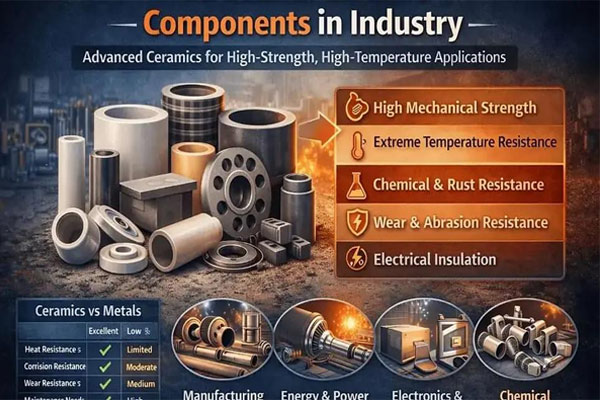
Unlike the ceramics you see in pottery or tiles, technical ceramics – also called advanced or engineering ceramics – are precision-engineered materials manufactured to meet strict industrial specifications. They include materials like:
- Alumina (Al2O3) – the workhorse of electrical insulation
- Zirconia (ZrO2) – famous for toughness and thermal resistance
- Silicon Carbide (SiC) – the champion of hardness and chemical resistance
- Silicon Nitride (Si3N4) – light, strong, and shock-resistant
- Boron Carbide (B4C) – one of the hardest known materials on Earth
These are not fragile, breakable materials. They are engineered to survive where metals fail.
5 Reasons Ceramics Are Outperforming Metals
Superior High-Temperature Performance
Steel begins to lose its mechanical strength above 500°C. Most aluminium alloys give up even earlier. Technical ceramics, on the other hand, can operate reliably at temperatures exceeding 1600°C. In furnaces, induction heating systems, and combustion environments, ceramics simply last longer and perform better.
Extraordinary Hardness and Wear Resistance
Metal components in pumps, valves, and textile machinery wear down over time due to friction and abrasion. Ceramic components made from silicon carbide or alumina can last 5 to 10 times longer in the same conditions. Fewer replacements mean reduced downtime and lower maintenance costs.
Electrical Insulation - Flawless and Reliable
In electrical and electronic systems, the cost of insulation failure can be catastrophic - both financially and physically. Technical ceramics offer electrical insulation properties that plastics and most metals simply cannot match, especially at elevated temperatures where polymers degrade rapidly.
Corrosion and Chemical Resistance
Metal corrodes. It rusts in humid environments, reacts with acids, and degrades in chemical processing plants. Ceramics are chemically inert. In pharmaceutical, chemical, and water processing industries, ceramic components maintain their integrity where stainless steel eventually fails.
Weight Advantage Without Sacrificing Strength
Silicon nitride bearings, for example, weigh 60% less than steel equivalents while maintaining comparable load-bearing capacity. In aerospace and electric vehicle applications, reducing component weight directly translates to fuel efficiency and extended battery range.
Where Is the Transition Happening Right Now?
The replacement of metal by ceramics is already well underway in several key sectors:
- Electric Vehicles (EVs): Ceramic battery insulation and brake discs are becoming standard in premium EVs.
- Semiconductor Manufacturing: Ceramic substrates and components are essential in chip fabrication environments.
- Aerospace: Lightweight ceramic components are used in turbine engines and structural parts.
- Industrial Pumps and Seals: Ceramic plungers and rotary seals dramatically extend service life.
- Medical Devices: Zirconia is widely used in dental implants and surgical tools.
The Economic Argument
Critics often point to the higher upfront cost of ceramic components compared to metal. And they’re right – ceramic parts can cost more initially. But when you factor in longer service life, reduced maintenance, elimination of lubrication requirements, and lower downtime costs, the total cost of ownership often favours ceramics significantly.
A metal pump seal replaced every 6 months costs far more over 5 years than a ceramic seal installed once and forgotten.
Conclusion
The shift from metal to technical ceramics isn’t a future possibility – it’s happening today, in factories, vehicles, and laboratories around the world. The question is not whether ceramics will replace metals in your industry, but when, and whether you’re ready.
As Indian manufacturing scales up under Make in India initiatives, domestic access to high-performance technical ceramics is becoming a strategic advantage – not just a procurement choice.