Zirconia vs Silicon Nitride vs Alumina Bearings: Which One Fits Your Application?

Industrial Applications of Ceramic Bearings

Steel bearings fail in ways that are entirely predictable. They corrode in wet or chemical environments, they generate heat at high speed, and they need constant lubrication to survive. Ceramic bearings solve most of those problems, but “ceramic bearing” isn’t one material. Zirconia, silicon nitride, and alumina behave differently enough that picking the wrong one can mean choosing a bearing that’s technically ceramic but still wrong for the job.

Here’s how the three actually compare, so you’re specifying based on what the application needs rather than just “ceramic vs steel.”

 

Best Ceramic Bearing Materials for Different Applications

Zirconia (ZrO₂): Best for Toughness and Corrosion Resistance

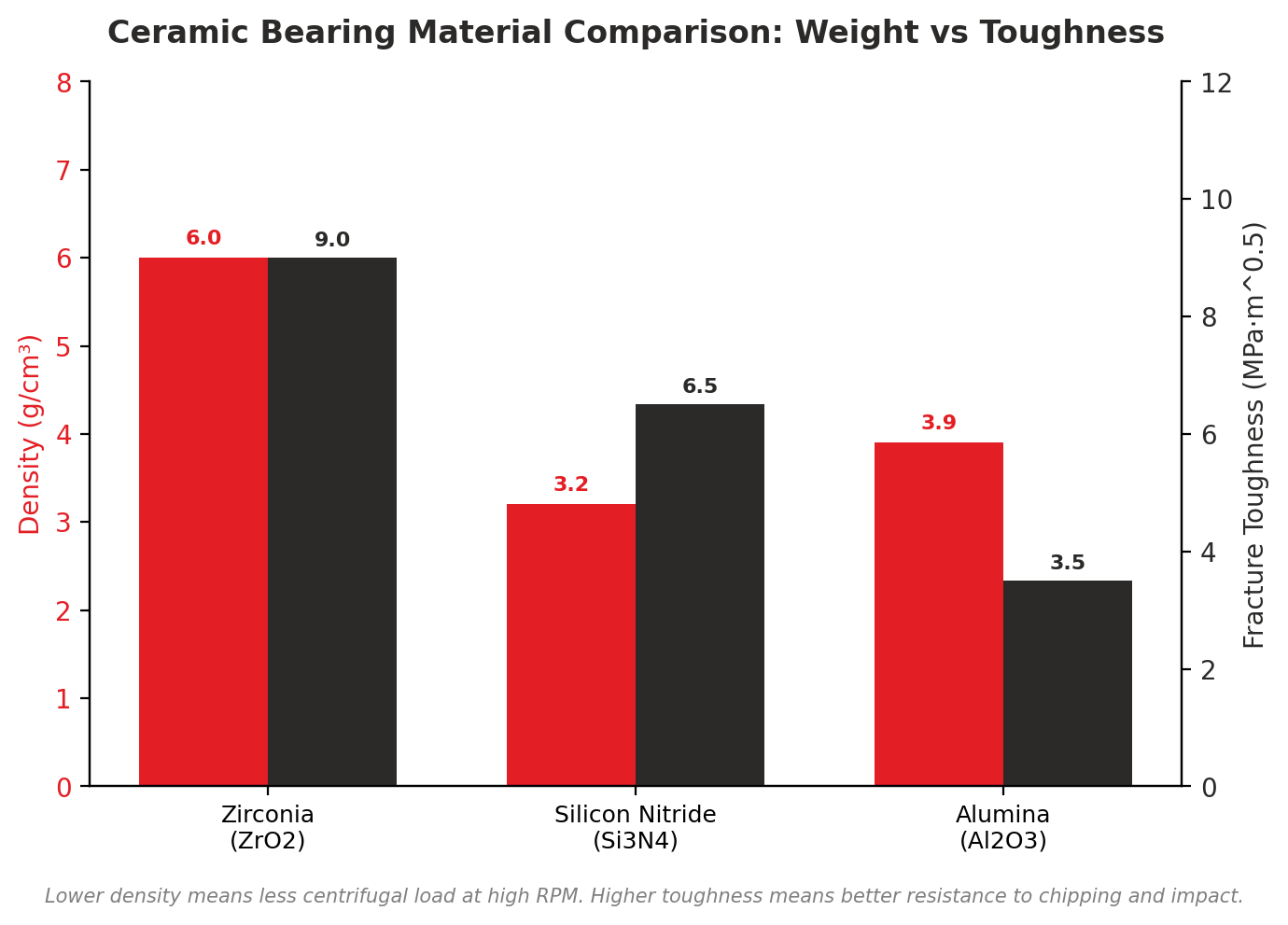
Zirconia is the toughest of the three ceramic options, with
fracture toughness closer to some tool steels than to typical ceramics. It also
handles impact loading better than alumina or silicon nitride, making it a
strong choice where shock loads are a factor and not just steady state
rotation.

Silicon Nitride (Si₃N₄): Best for High Speed and Low Weight

Silicon nitride is what most people mean when they say “ceramic bearing” in a high performance context. It’s roughly 40% lighter than steel, which reduces centrifugal loading at high RPM, meaning the bearing generates less stress simply by spinning fast. It also has better thermal shock resistance than zirconia and handles rapid temperature swings without cracking.

Alumina (Al₂O₃): Best for Cost-Effective Wear and Insulation

Alumina is the most economical of the three and still delivers strong wear resistance and hardness, along with excellent electrical insulation. That’s useful in applications where you specifically need to prevent electrical current from passing through the bearing, which is common in electric motors and generators to prevent bearing fluting from stray current.

Where Each Ceramic Bearing Performs Best

Zirconia (ZrO₂)

Chemical processing equipment, food and pharmaceutical machinery where corrosion resistance and non reactivity matter, and applications where some impact or shock loading is expected alongside rotation.

Silicon Nitride (Si₃N₄):

High speed spindles, aerospace and precision machine tool applications, and hybrid bearings (ceramic balls with steel races) where the goal is reducing weight and heat generation without the cost of a full ceramic bearing.

Alumina (Al₂O₃):

General industrial applications where full ceramic performance isn’t required but corrosion resistance, electrical insulation, or moderate wear resistance matters, and budget is a real constraint.

Quick Comparison For: Zirconia vs Silicon Nitride vs Alumina

Zirconia (ZrO₂)

Zirconia bearings offer high toughness, excellent wear resistance and strong corrosion resistance. They are well suited for wet, chemical and industrial environments where durability and resistance to impact are important.

Silicon Nitride (Si₃N₄)

Silicon nitride bearings are lightweight, strong and ideal for high-speed operation. Their low density and excellent thermal-shock resistance make them suitable for precision machinery, electric motors and high-RPM applications.

Alumina (Al₂O₃)

Alumina bearings provide high hardness, good wear resistance and excellent electrical insulation. They are a practical choice for electrical equipment, general industrial machinery and applications where reliable ceramic performance is required.

Industrial Applications

Zirconia (ZrO₂)

  • Chemical processing equipment
  • Food & beverage machinery
  • Pharmaceutical equipment
  • Pumps and valves
  • Corrosive environment machinery
  • Wet processing systems

Silicon Nitride (Si₃N₄)

  • High-speed machine tool spindles
  • Electric motors and generators
  • Aerospace equipment
  • Precision machinery
  • High-speed pumps
  • Automotive and EV systems

Alumina (Al₂O₃)

  • Electrical equipment
  • Industrial automation systems
  • Laboratory machinery
  • General manufacturing equipment
  • Chemical handling systems
  • Light-duty precision machinery

Frequently Asked Questions

What is the main difference between zirconia, silicon nitride and alumina bearings?

Zirconia offers high toughness and corrosion resistance, silicon nitride is ideal for high-speed and high-performance applications, while alumina is known for hardness, wear resistance and electrical insulation.

Silicon nitride bearings are generally preferred for high-speed applications because they are lightweight, strong and resistant to thermal shock.

Zirconia bearings are a strong choice for corrosive and wet environments because of their excellent corrosion resistance and mechanical toughness.


    captcha
    Please Enter Text Here